Listen beyond the bark
Barking is only a small part of what dogs say. Most of their communication happens through posture, movement, ears, eyes, mouth and tail, often in quick combinations. Learning to read those signals in context is one of the most useful skills a guardian can build, because it lets you respond while your dog is still speaking quietly.
Context comes before any single signal
No single signal has one fixed meaning. A yawn can mean a dog is tired, or that it feels uneasy in a waiting room. Lip licking might follow a meal, or a stranger leaning over. So the first question is always: what is happening around the dog right now? A new place, a loud noise, an unfamiliar person or another dog approaching all change how you should read the same movement.
Individual dogs differ, too. Breed type affects how ears and tails are carried, some coats hide raised hackles, and each dog has its own habits. Watching your dog when it is clearly relaxed gives you a baseline to compare against.
Read the whole dog, not just the tail
It helps to scan from nose to tail rather than fixing on one part.
- Body: loose and wiggly, or stiff and still? Weight shifted forward or back?
- Face: soft eyes and a relaxed, slightly open mouth, or a closed mouth, tight lips and wide eyes?
- Ears: in their natural position, pricked forward with interest, or pinned back?
- Tail: its height, speed and stiffness compared with how your dog usually carries it.
- Movement: curved, bouncy approaches usually feel friendlier to dogs than straight, direct ones.
Common signals and calm responses
| Signal | What it can mean | A helpful response |
|---|---|---|
| Loose, wiggly body with a soft face | Relaxed or friendly | Carry on, while still checking how the dog responds to touch |
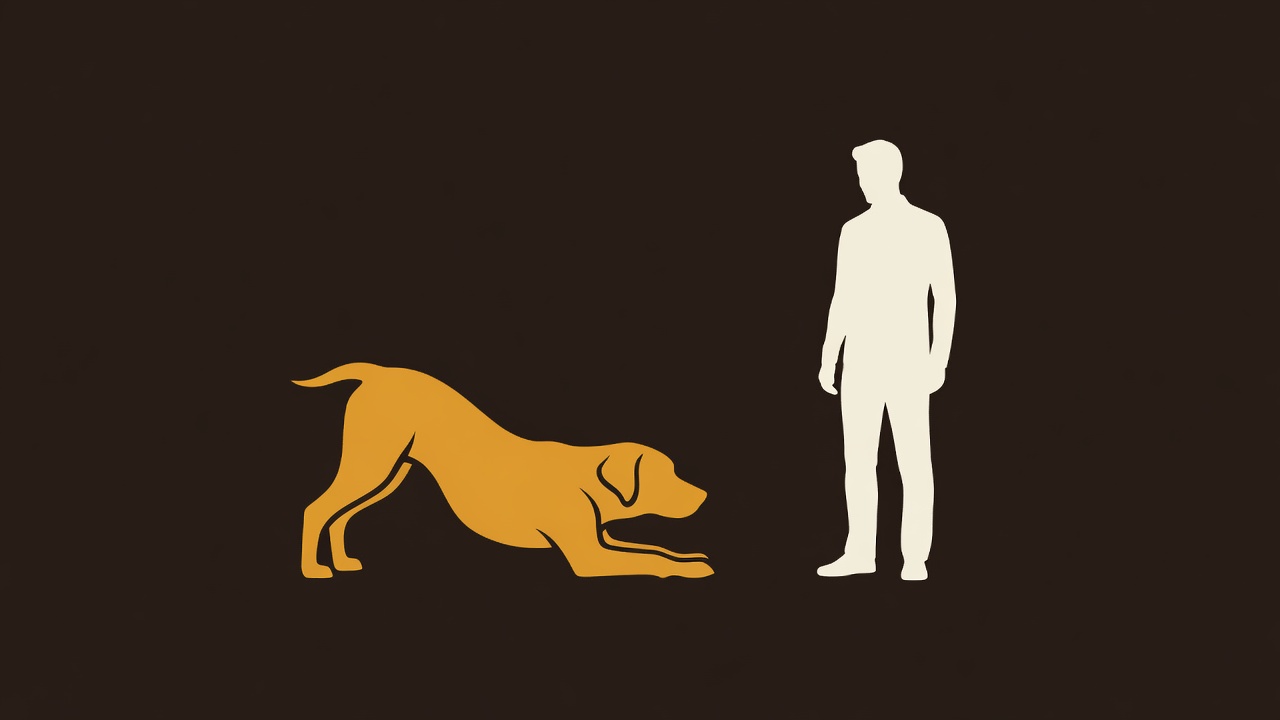
| Play bow, front end down and rear up | An invitation to play, or a sign that rough-looking play is meant kindly | Join in or allow play, with breaks so excitement doesn't build too high |
| Yawning, lip licking or shaking off out of context | Mild stress or uncertainty | Reduce pressure: add distance, slow down or end the interaction |
| Turning the head or body away | A polite request for space | Give space and don't follow the dog to continue |
| Whites of the eyes showing, often called "whale eye" | Discomfort, often while guarding something or being held | Calmly step back and avoid reaching over the dog |
| Sudden stillness or freezing | Strong unease; a warning may follow | Stop what you are doing and create space |
| Tail tucked, body lowered | Fear or anxiety | Let the dog retreat; don't force contact or hold it to comfort it |
| High, stiff tail with a short, fast wag | Arousal, which may be excitement or tension | Check the rest of the body and calmly redirect attention |
Small signals come before big ones
Many dogs follow a rough progression when they are uncomfortable. It may start with subtle signals such as looking away, licking the lips or turning aside, then move to clearer ones like stiffening, staring, lifting a lip or growling before a dog ever snaps. The order and speed vary between dogs, but the pattern matters: if quiet signals are repeatedly ignored, a dog may learn to skip straight to louder ones.
That is why punishing a growl is risky. A growl is information. Removing it does not remove the discomfort underneath; it only takes away the warning. A better response is to stop, give space and later work out what triggered the reaction.
Barks, whines and growls
Sounds are easier to notice but just as dependent on context. Barking can signal alertness, excitement, frustration, a request or fear, and its pitch, rhythm and the body language around it usually tell you which. Whining often accompanies wanting something or feeling unsettled. Play growls tend to come with bouncy, loose movement, while a warning growl usually arrives with stillness and a hard stare.
If barking becomes a problem, start by asking what the dog is reacting to or what it gains from barking, rather than only trying to stop the noise.
When signals change suddenly
A dog that suddenly avoids being touched in one area, stops jumping onto furniture, licks one spot repeatedly, or becomes unusually restless or withdrawn may be telling you something about its body. Changes like these are worth discussing with a vet, who can look for pain or illness before you treat them as purely behavioural.